
1Gateway is a data integration product to connect disparate IT Management systems to keep data accurate and complete across boundaries.
Typical Use-Cases
ITSM Ticket Synchronization
Automates ticket creation and ticket updates across multiple ticketing systems, enabling seamless real-time collaboration between teams and organizations.
ITOM Monitoring & Alerting
Consolidates alarms and metrics from multiple monitoring tools into a single pane of glass, enabling operational efficiency and proactive management in a heterogeneous environment.
CMDB Integration
Collects and updates configuration item (CI) information from the ecosystem into a centralized CMDB, providing a single, reliable source of truth for assets and services organization-wide.
Cross-Organization Collaboration
Facilitates secure data exchange of systems such as ITSM and ERP systems between business partners through 1Bonding.
Architecture
1Gateway’s core engine standardizes data from multiple systems into a unified, normalized format. Using easy-to-configure rules, it ensures the data is accurately routed to the appropriate destination.
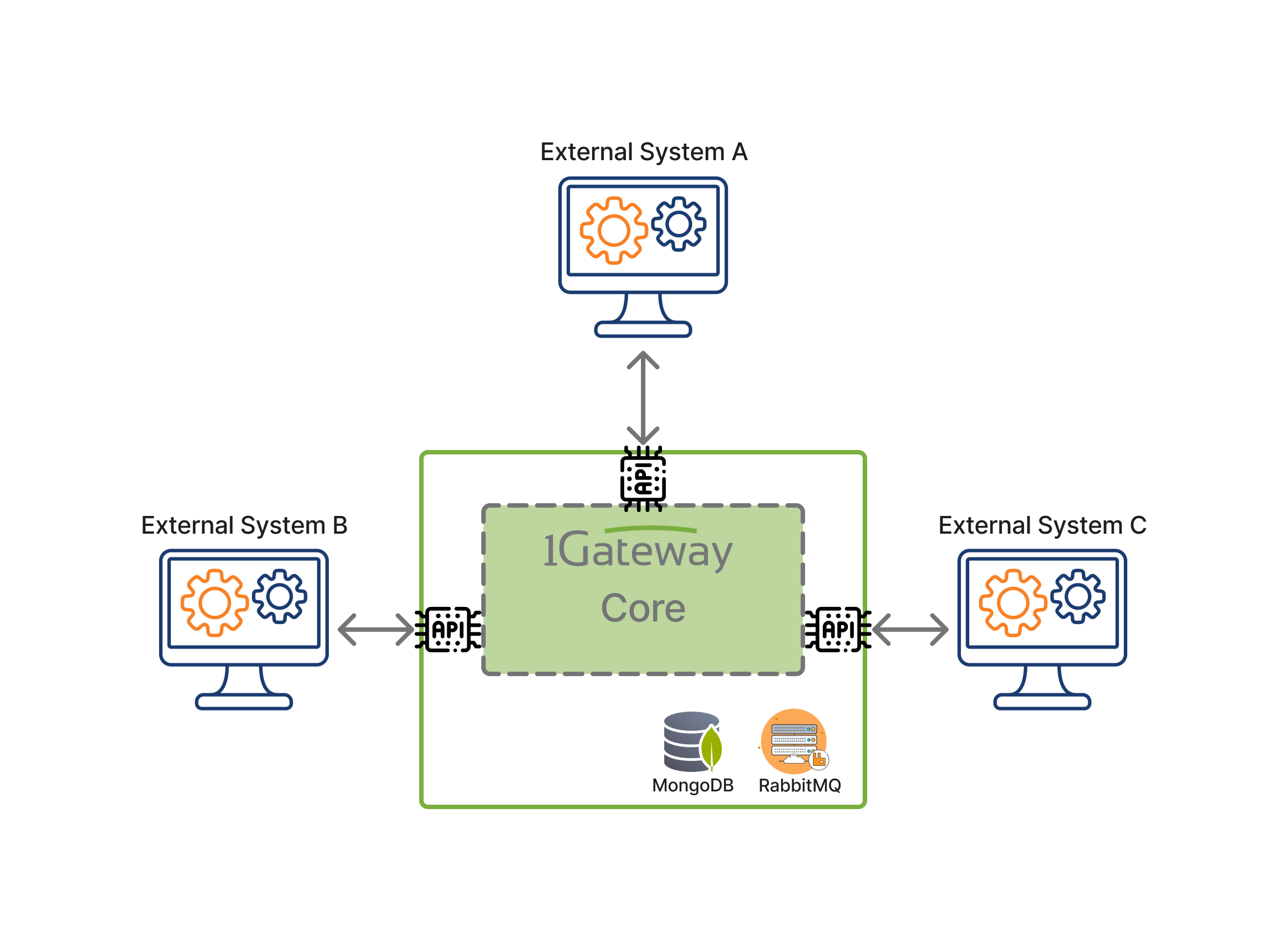
1Gateway follows a layered architecture, ensuring modularity and scalability and includes the following building blocks:
Building Blocks
-
1Gateway - The Core Responsible for message transformations, routing, queuing, flow control, persistence, ID mapping, and security. It orchestrates integration logic across different systems and exposes a REST API to facilitate web-based data exchange.
-
RabbitMQ Ensures reliable, asynchronous message queuing by assigning a dedicated queue to each outgoing connection. Failed deliveries are captured in dead-letter queues for later handling.
-
MongoDB Serves as the persistent store for configurations, states, and metadata.
Functional Blocks
1Gateway is made up of the following functional blocks:
Plugin
A plugin specifies how data is processed for integration with 1Gateway. The following Plugin categories are available:
- Inbound Plugin – Responsible for collecting data from external systems.
- Outbound Plugin – Responsible for delivering data to external systems.
- Generic Plugin – Used for routing purposes within 1Gateway.
- System Plugin – Used for internal 1Gateway functionality.
Mapper
A mapper consists of multiple mappings that specify how data is transformed from one system to another, enabling seamless integration and interoperability.
Mapping
A mapping is a configurable rule within a mapper that defines how specific data fields in a message are transformed. It can also access data from third-party systems to enrich the message before it is sent to its destination.
Endpoint
A 1Gateway Endpoint holds the information necessary to access a system to either retrieve or send messages, such as URLs and credentials. A system can encompass various types of technologies, such as:
- IT Service Management (ITSM) tools: ServiceNow, ServiceWare, Jira
- IT Operations Management (ITOM) tools: SolarWinds, Prometheus, Dynatrace
- Cloud-based applications: Office 365, Salesforce
- Databases: MongoDB, PostgreSQL
Message Flow
A message represents an individual unit of data transmitted via 1Gateway between two endpoints (external systems).
1Gateway operates on a message-based communication model. Each message is a nested key-value structure, tagged with a message type that defines the format and context of the data it carries.
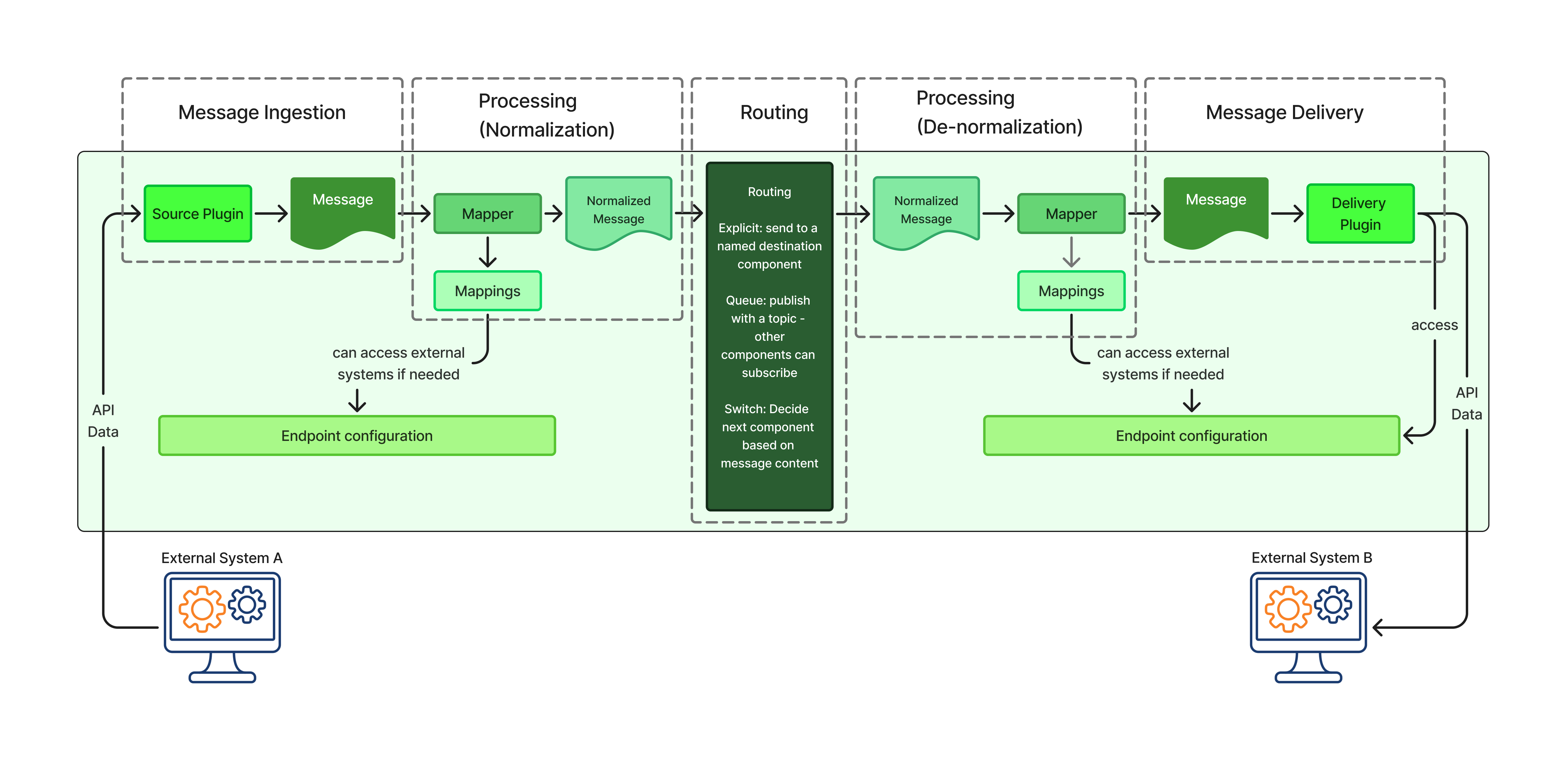
The flow of a message involves the following steps:
- Message Ingestion: Retrieved message from an external system.
- Processing (Normalization): Transformed message and mapped into a standard format.
- Routing: Forwarded message based on predefined rules.
- De-normalization: The message is converted into the format supported by the destination system.
- Delivery: Sent message to the destination system.
This normalization and de-normalization cycle ensures that plugins are reusable and remain compatible with future integrations.